The History of Baseball in Bismarck
Baseball has been part of the Bismarck community for more than 150 years. From early games played in the 1870s to the legendary Bismarck Grays and Satchel Paige, the Barons, Pards, Dakota Rattlers and generations of American Legion players, Bismarck baseball history is filled with unforgettable teams, players and moments.
Explore the history of baseball in Bismarck and discover how the game grew from early local clubs into a tradition that continues in the community today.
The First Games in Bismarck | 1873 - 1876
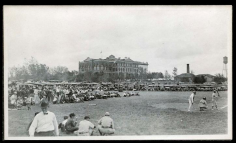
Bismarck’s first games were played before the snow melted in the spring of 1873 when Edwinton, (Bismarck’s first name,) was little more than a collection of shacks and tents on the prairie. The teams were made up of soldiers stationed at Fort Hancock, near present day downtown Bismarck, made up from infantry and cavalry companies. They played teams from Fort Buford, Fort Rice, and the Black Hills. One of the best known early clubs was the Actives.
The National Fever Hits | 1877
By 1877, Bismarck’s gunfights faded and the gamblers left town. Townspeople needed entertainment! For the Fourth of July, Burleigh County officers challenged nine city merchants to a game at a field on the far western edge of town. The purpose was to raise money for a school under the patronage of St. Mary’s church. The merchants won, and the team stayed together, taking on all comers through the summer. The city’s main ball diamond was south of the tracks, near the stage coach barn.
The Bismarck Nines | 1879 - 1885
Each season brought a new collection of local players and a new “regular” Bismarck nine. The Bismarck Blue Stockings represented the city in 1877. By 1883, Bismarck’s firemen had organized The No. 1 Hards, named after spring wheat. The No. 1 Hards built their own grounds near the city race track to the east. Everyone wanted a team to challenge the Actives, now at Fort Abraham Lincoln, and the No. 1 Hards. The Bismarck Tribune formed the Advertiser Nine. Doctors formed a team to play a team of lawyers. Saloon keepers challenged all comers. Two boarding houses squared off against each other; the Hotel de Stewart beat the Falconer Boarding house, after which the city’s hotels put teams in the game. There were mixed citizens teams, too, with names such as the Muffers who played the Butter Thumbs. A Baseball Association raised money to fence the race track field. At the end of most seasons, the teams disbanded to reorganize the next spring. In December 1885, however, the season went on. Two games were played between the city’s prominent men.
The Baseball Fever Spreads in Bismarck | 1886 - 1891
Baseball grew. The No. 1 Hards, still the “regulars,” played against the White W.B. Bell’s Nine, the Blue Stockings, and the Capitol Nine. Boys formed their own teams; the White Stars challenged the Jim the Wizzards’ Lightening team.
In July 1886, the earliest reported women’s game was played. Eighteen young women practiced and played near the home of Amos Robidou on the south side of town. They organized a team of their best nine to challenge a team of young women from Mandan. A new diamond, the Summit Grounds, was built on the Capitol grounds.
Farther Afield | 1887 - 1902
Bismarck teams traveled by train to play clubs from Mandan, Steele, Grand Forks, and Dickinson. Bismarck defeated Grand Forks three times, claiming bragging rights as unofficial state champions. The city staged city championship games including contests between the White Stockings and the Red Stockings. Fourth of July baseball remained a major attraction. In 1887, the featured game was the Lean Men against the Fat Men. Doctors still played the lawyers. Hotels still played the boarding houses. On the grounds of the Episcopal church on Third Street, the Pansy Blossoms played the Brick Bats. The young women of Bismarck created a championship belt to be awarded at the end of a series that determined the city champions.
A City Ball Field in Bismarck | 1903
In 1903, local baseball manager William A. Falconer petitioned the city to build a different baseball diamond south of the railroad tracks. There was a small problem. His plan would put the new baseball park 10 feet into the street. The plan was approved. The new grandstand held about 500 spectators. To celebrate, Bismarck invited the champions of the Twin Cities, the Palace Clothiers of St. Paul, to come play. Bismarck lost miserably.
If You Build It, They Will Come | 1903 - 1911
Teams arrived from Dickinson, Fargo, Apple Creek, Sterling, and Standing Rock. The Bismarck nine played the National Guard’s Company A team and visiting semi-professional teams. Leagues appeared and disappeared, including one league with 20 teams. Women’s baseball teams were called “bloomer teams.” Bismarck had its own Star Bloomer Girls team. They challenged the men’s Capitols but lost badly. Taking the defeat in good humor, they hosted a street dance afterward. The ballpark became a place for youth games, for teams from every school, including the Sister’s School, the Indian School, the Reform School, and St. Mary’s.
The standout youth club in Bismarck in 1910 was the Toozes. They were fast, played teams from other towns, and challenged adult business teams. They became well known around the region.
Bismarck hosted one of the era’s most unusual baseball attractions in the summer of 1910. The Hopkins Bros. Bloomer Girls out of Des Moines, Iowa, arrived on July 17th. The traveling women’s team was famous for drawing large crowds to watch them play against men’s teams. They came prepared. They brought their own fence, 1,400 feet of canvas, a covered grandstand, and an electric arc light generator. It was Bismarck’s first game played by electric light. There was a little show-business going on, as it was well known that some of the players were men wearing long-haired wigs.
The 63-Mile League | 1911 - 1918
A new ballpark was built near the Capitol, with room for 1,200 spectators, a first-class grandstand, and a fence. The Bismarck adult teams organized the new 63-mile League drawing clubs from towns within 63 miles, including Flasher, Mandan, New Salem, Fort Lincoln, and Glen Ullin. The teams adopted color names: Red Sox, White Sox, and so forth. Mandan claimed the Gray Sox. The young Toozes were left out, but changed their name to the Maroons, and raised money for fancy new suits.
The White Sox became Bismarck’s official team and often used the Toozes for practice. Many of the Toozes went on to colleges in the Twin Cities, including several who played for St. Thomas College in St. Paul. The young men returned to Bismarck during the summers to play semi-pro ball.
Bismarck’s teams also played traveling Black clubs, including Minnesota’s Colored Gophers and the St. Paul Colored Keynotes.
Another diamond was built at the corner of Front Avenue and 13th Street. The penitentiary also organized a team, the Grove All-Stars. The team was allowed to play in nearby towns, until two players took advantage to escape. After that, a diamond was established inside the prison grounds.
Bismarck girl’s baseball teams took over the fields for practice on Wednesdays. In 1916, another famous women’s baseball team came to Bismarck to challenge the local nine. The All Americans included a well-known first baseman who adopted the nickname “Carrie Nation.” Miss Nation returned to play in Bismarck several times, always filling the stands.
Presidential Visit | 1919
At the close of WWI, President Woodrow Wilson stopped in Bismarck on a whistle stop circuit around the nation, promoting his peace treaty and the establishment of the League of Nations. The President spoke at the Bismarck City Auditorium, then continued westward on his journey. To entertain the 5,000 visitors who came to see the President, the afternoon featured a daredevil aviation exhibition, and, at the Capitol Grounds, a baseball game for the championship bragging rights to the Missouri Slope title. The 10-inning game between Halliday and Wilton was won by Wilton by a score of 7 to 6.
That summer, the Bismarck ballpark saw another visit by the American Athletic Girls Bloomer Team, which also starred Carrie Nation, who was promoted as the “World’s Greatest First Base Woman.”
Changes | 1920 - 1926
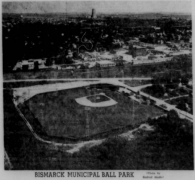
The next summer, the baseball diamond on the Capitol grounds, most often used by the Bismarck High School baseball team, was plowed up to plant landscaping trees, leaving the city without a suitable ball park. Temporary fields were established on the golf links at Tom O’Leary. That summer, a series of baseball games were used to raise money to build the new Elks Swimming Pool. The city organized to build a municipal ballpark on Front Avenue, the one that is the center of Bismarck baseball today. The Valley City Hi-Liners, a minor league team, moved to town and became the Bismarck Capitals; however, the experiment wasn’t long lived. Still, Bismarck had gotten a taste and wanted more.
The Governors and the Rise of Youth Baseball | 1927
While the local adult teams came and went, another Bismarck baseball tradition was taking root: American Legion baseball. The Llyod Spetz Post No. 1 organized in 1927-1928, and the Bismarck Governors would become one of the most enduring youth baseball programs in North Dakota.
The Bismarck Grays | 1926 - 1933
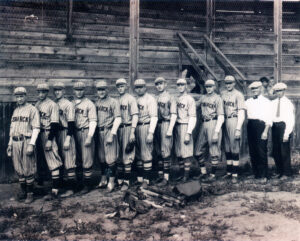
In 1926, fourteen local businesses pledged to buy new uniforms for a new amateur independent team. This time they wanted an all-home team, and insisted the local players share any money raised. Businessmen William Kontos and Neil Churchill began organizing a new team. Churchill became the player/manager for the new Bismarck Grays.
The Bismarck Grays were made up mostly of local players, including chiropractor Dr. H. B. Love, the pitcher, who lived on The Red Trail Farm, northwest of Mandan. Love pitched 40 scoreless innings in 1926. Other players included former soldiers, semi-pro players, and
big-leaguer, Charlie Boardman, a southpaw, who the newspapers described as being “feared as the greatest pitcher in North Dakota for a number of years.” The Grays were not a salaried team at first but found jobs with local businesses.
A traveling semi-pro team, the All Nations of Kansas City came to Bismarck to play. The All Nations team represented fifteen different nations and backgrounds: Italian, Spaniard, Swede, Irish, Yankee, Japanese, Chinese, Cuban, Russian, Jewish, Norwegian, German, Polish, Englishman, and a Scot. They traveled and worked with the Robbins Brothers circus. The first performance of the circus in Bismarck sold out, and a second was abruptly announced. The ball players, not allowed to leave their posts, had to forfeit the game.
The Grays played the House of David team, a club of long haired men, with flowing beards, and strong religious beliefs, who came from a colony in New York. During these years, the Grays hosted all Black teams, including the McCoy-Nolan Colored Giants of Milwaukee and the Colored Black Sox of Minneapolis, who brought their own band and orchestra and put on a pavement dance after the game.
The second year, Neil Churchill gave the team all new gray uniforms with blue stripes and black caps. The uniforms included shoulders that were looser, caps with buttons and peaks, more belting than the previous uniforms, gloves for one hand only, and new boots.
Local builder John A. Larson and Greek confectionary owner William Kontos rejuvenated the dugouts, added new roofing for the grandstand, replaced weak boards in the fence, and built a new press box.
The Gray’s mascot was little Orlando “Freckles” Johnson, an 8th grader, weighing 93 lbs. He was given a complete baseball uniform, and assigned to take care of the bats, get water, set out the lines on game day, and peddle bills in the stands.
On July 4, 1928, a woman stunt plane artist performed acrobatics over the ball park, and two women parachuted into the park. Athletic contests for the city children during the games included a chicken scramble, where 12 live chickens were thrown from the grandstand, each having a one-dollar bill attached to one leg. Whoever caught the chicken received both the chicken and the money.
The city’s service clubs and the Chamber of Commerce turned over the Bismarck baseball park to the Bismarck Park Board on July 18. They had originally bought the ballpark for approximately $2,750, including the ball grounds, grandstand, and six and ¾ acres of ground, with the intention of it eventually becoming part of the city’s park system. When the it was obtained by the Bismarck Park Board, it was valued at $4,000. At the dedication, a Chevrolet sedan was given away with a raffle.
The next year’s team included George “Ducky” Guidas, a former McCoy-Nolan Colored Giants player, and Joe Day, a Native American who previously played for the All Nations. Still, the Gray’s players weren’t paid a salary; instead, they received compensation from gate proceeds, on a point system for games played, practice attended, games pitched, and practices managed.
The Satchel Paige Era in Bismarck | 1933 - 1935

The 1926 Bismarck Grays. Churchill is pictured 7th from the left.
Bismarck spectators were accustomed to seeing diverse teams, but would they support an integrated team of their own? In 1933, Neil Churchill bought the Grays. The Jamestown team roster included several Black players: Barney “Lefty” Brown, Willie Foster, Wild Bill Freeman, and brothers Charlie and Art Hancock. For the Bismarck Grays’ 1934 season, in addition to Ducky Guidas, Churchill recruited Black players Roosevelt Davis, a pitcher, Harold Massmann, and the most outstanding, Leroy “Satchel” Paige. Satchel Paige was the leading right-handed pitcher, to play in the Bismarck August 13th, debut. In Bismarck, the Black players were sometimes met with racism away from the field, being refused in restaurants and lodging. Some players stayed with local Black families. At the same time, they drew enormous crowds. The Labor Day game filled the ballpark with 7,000 fans.
For the next season, Churchill assembled a powerful semi-pro team that was truly remarkable and quickly became a regional attraction. In 1935, the team went to the National Semi-Pro Baseball Tournament in Wichita and became the first integrated team to win the national championship.
A Series of Strong Amateur Teams | 1940s - 1950s

Back in the Pros | 1954 - 1957

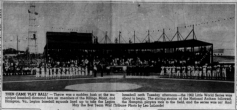
The youth games continued to draw large crowds. New bleachers were erected when the city was chosen to host the American Legion’s 5-day National Junior Baseball Tournament called the Little World Series in 1956. Four teams came to Bismarck to play: one from New Orleans, LA; one from St. Louis, MO; one from Yonkers, NY; and one from Roseburg, OR. A 40-piece Navy band from Illinois provided musical color. Huge crowds watched the team from St. Louis win the title. The event’s logo and theme were seen everywhere across Bismarck, including a special “Drive-In Church” service held at the Corral Drive-In Theatre that focused on baseball.
The Pards Play Ball | 1959 - 1968

The Bismarck Tribune, 1962, Aug 29, Page 1 Leo Lalonde photo
In the summer of 1959, the great Satchel Paige returned to Bismarck for two exhibition games with the Cuban All-Stars.
In 1962, Bismarck again hosted the American Legion’s Little World Series. This time, eight teams competed. National news reporters and radio broadcasters came to town. A tryout camp before the tournament brought 35 scouts from 20 major league teams to Bismarck.
The tournament’s new cowboy hat-wearing mascot was named “Sunny Nodak.” Merchants sold commemorative coins and souvenir booklets, colorful ties and bumper stickers. Once again, the team from St. Louis, MO, won the series, defeating the team from Honolulu, HI, who didn’t appreciate temperatures in the low 50s during the evening title game.
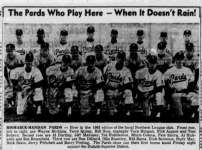
The same year, a new semi-pro team organized. The name that won the competition for the new Bismarck-Mandan team was Partners; however, the team typically used the nickname, the “Pards.” The team joined the Northern League as a Minnesota Twins affiliate. One of the new Pards players, pitcher Bill Oerding, had pitched a winning 15-inning game in the Little World Series in Bismarck six years earlier in 1956.
During the next season in 1963, twelve of the Bismarck Pards and their coach were injured when their team bus crashed returning from a night game in Williston. The coach healed slowly, and he had to shout to his assistant coach from his wheelchair behind the spectator fence. In addition to the injuries, it was a tough financial year for the Pards; they went inactive the next year.
It wasn’t all bad. Satchel Paige and his All-Stars once again returned for an exhibition game that summer. Paige pitched the first five innings, and the All-Stars went on to win.
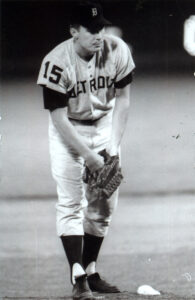
Fred Lasher
Although the Pards remained inactive, the following year, Bismarck’s baseball scene grew! The Junior Legion A and B teams were highly successful. Bismarck’s youth signed up for recreation baseball, Little League, Babe Ruth leagues, and high school and junior college teams. The city’s annual baseball round robin recreation competition attracted 900 ballplayers to decide the city champion in each league. There were several amateur men’s teams, including a new baseball team called the Amateurs, formed by Tom Woodmansee, that kept the fans entertained for a season. For those who wanted to play on the field, there were many, many softball teams.
The following year, the Northern League enticed the Pards to come back as a Houston Astro’s farm club. A team of 19 players was fielded. It was another rough year for the Pards, coming in last place. The Astro’s canceled their contract, and the team went inactive again, never to return.
Fred Lasher was an outstanding relief pitcher for the Bismarck Pards. After the 1962 season, he would move up to the Minnesota Twins. Eventually traded to the Detroit Tigers, he would become the closer for Dennis McLean, and in 1968 he would become the second Bismarck pitcher to win a World Series ring.

Bismarck Baseball Returns to the Community | 1969 - 1976
Bismarck baseball culture was alive and well! In 1969, a new amateur Bismarck team organized, with young Bob Cordova, a longtime Bismarck High School English teacher, as a player/manager. The team played an exhibition game wearing the old Barons and Pards uniforms that the Junior College had kept.
In the early 1970s, the Bismarck Park Board approved the construction of a new grandstand and new fencing at the Municipal Ballpark. The Bismarck Park Board rushed to finish the covered, concrete stands in time for the North Dakota American Legion Baseball Tournament in August of 1971. The Governors won the state championship. Bismarck now had six major baseball parks on North Washington Street, Sertoma-Riverside Park, Simile Jr. High, Rita Murphy School, Airport Road, and the 14th Street Playground.
The mid-70s saw several new amateur teams come and go, including the Bismarck Merchants with 15 players and the Bismarck Capitols who painted homes to raise money. Gate receipts for the adult games remained low; Bismarck spectators just wouldn’t show up for the semi-pro games. By 1976, the citizens of Bismarck seemed to have become a community that wanted to play on the diamond, rather than watch from the stands. It had become a softball town. The first annual charitable softball tournament, founded by Sam McQuade, Sr. to raise money for Muscular Dystrophy, was a great success; one hundred three teams entered.
The Governors continued to win state championships. Parents coached, grandparents filled the stands, teenagers worked concessions. The game was part of Bismarck’s culture. Girls and women tended toward softball and those leagues became important.
Another Strike Out | 1995-1996
It was a while before the city tried again. In 1995, the Dakota Rattlers, a minor league team, formed. The launch was assisted by pitcher and former Minnesota Twin, Tony Oliva, who came onboard to help to boost the new Bismarck club. The Rattlers did not play well. Given the 26 year gap since Bismarck had supported a professional team, it came as little surprise that Bismarck had become a town where Legion Ball and high school sports
prevailed, with softball right on its tail. Attendance at the Rattlers games suffered, and the gate receipts couldn’t cover costs. It would be another twenty or so years before Bismarck would bring back professional baseball.
All the While | 1990s - 2000s
The Governors carried the baseball institutions forward, adding more state champion banners and trophies. The youth and high school teams carried on. Girls fastpitch and softball programs grew, giving girls their own way to play. The Governors won another championship in 2014, bringing their total to 12. The Governors had been part of Bismarck baseball history for nine decades.
The Bismarck Larks Era | 2017 - 2026
In 2017, the Bismarck Larks brought collegiate summer baseball back to Bismarck, bringing players from around the country. The Larks mixed competitive baseball with entertaining promotions, theme nights, fireworks, family activities, and fun. They sold out 27 of 36 home games in their inaugural season. The team continues to sell out their games and the history of baseball in Bismarck lives on!
Today, Bismarck baseball serves 1,200 young players through recreational and competitive programs. In 2026, Bismarck added a Little League charter. Bismarck’s baseball tradition continues to grow!

This page is dedicated in loving memory of Dennis Boyd, Bismarck’s baseball historian.